

Introduction
For years, organizations have invested heavily in automation technologies to streamline repetitive processes, reduce operational costs, and improve efficiency. From automated data entry to robotic process automation and intelligent chatbots, businesses have successfully eliminated countless manual tasks. However, as digital ecosystems become increasingly complex, organizations are discovering that automating individual processes alone is no longer enough.
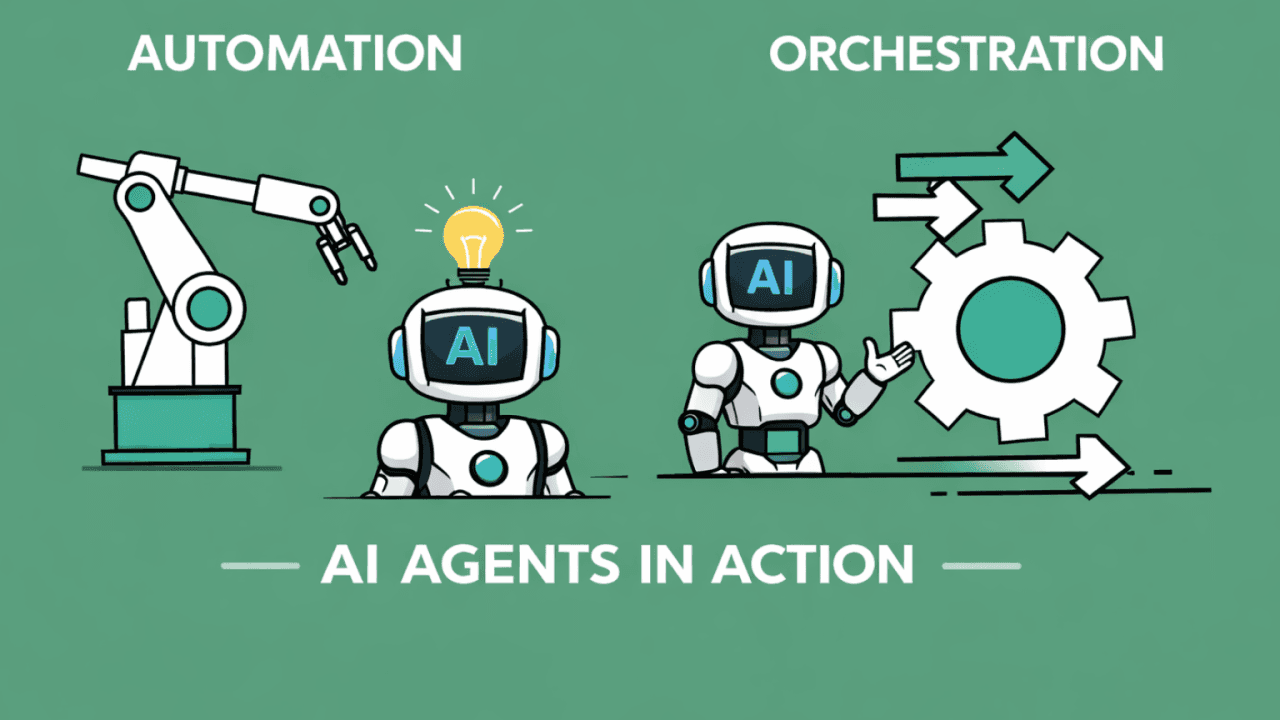
The next phase of enterprise transformation is AI orchestration. Rather than focusing on isolated tasks, orchestration enables multiple systems, applications, data sources, and AI models to work together as a coordinated ecosystem. This shift represents a fundamental change in how businesses operate, allowing organizations to move from simple automation toward intelligent, adaptive operations that can respond dynamically to changing business needs.
Why Automation Alone Is No Longer Sufficient
Traditional automation excels at handling predefined tasks within specific workflows. While this approach delivers measurable efficiency gains, it often creates disconnected processes that struggle to communicate across departments and systems. As organizations expand their digital capabilities, these isolated automations can become difficult to manage and scale.
Businesses today require solutions that connect workflows across multiple platforms, departments, and technologies. This need has accelerated interest in AI orchestration, where intelligent systems coordinate activities across the enterprise rather than operating independently. Organizations pursuing broader digital transformation initiatives often discover that orchestration delivers greater strategic value than standalone automation projects because it enables end-to-end process optimization.
Understanding AI Orchestration
AI orchestration goes beyond automating individual actions. It involves coordinating multiple AI systems, applications, and workflows to achieve broader business objectives. Instead of executing a single task, orchestrated systems manage entire processes while continuously adapting to new information and changing conditions.
For example, an AI-orchestrated customer service operation may integrate conversational AI, customer relationship management systems, analytics platforms, knowledge bases, and workforce management tools into a unified workflow. As customer interactions occur, the orchestration layer ensures that each system contributes relevant insights and actions in real time.
Organizations implementing solutions similar to those discussed in modern AI-powered decision intelligence strategies are increasingly relying on orchestration capabilities to maximize the value of enterprise data and AI investments.
The Rise of AI Agents and Autonomous Workflows
One of the most significant drivers of AI orchestration is the emergence of AI agents. Unlike traditional automation tools that follow fixed instructions, AI agents can make decisions, adapt to changing situations, and collaborate with other systems to achieve specific goals.
These intelligent agents are transforming how businesses manage operations. Rather than executing predefined scripts, agents can analyze information, prioritize actions, and coordinate with other systems autonomously. As multiple agents work together within orchestrated environments, organizations gain the ability to automate increasingly complex processes while maintaining flexibility and responsiveness.
The growing adoption of agent-based architectures reflects a broader industry trend highlighted by organizations such as IBM, which emphasizes the importance of intelligent systems working collaboratively to drive enterprise innovation.
Enhancing Operational Efficiency Through Orchestration
One of the most immediate benefits of AI orchestration is improved operational efficiency. When systems communicate seamlessly, businesses eliminate bottlenecks, reduce manual intervention, and accelerate process execution across departments.
Instead of requiring employees to transfer information between systems or monitor disconnected workflows, orchestration ensures that data and decisions flow automatically throughout the organization. This creates a more agile operating environment where processes can adapt in real time without requiring constant human oversight.
Organizations exploring intelligent automation solutions are increasingly finding that orchestration unlocks significantly greater value than automation alone because it addresses process complexity at scale.
AI Orchestration and Decision Intelligence
Modern enterprises generate enormous volumes of data from customers, operations, supply chains, and digital platforms. Converting this information into actionable insights requires more than advanced analytics it requires coordination.
AI orchestration enables organizations to connect data sources, analytical models, and decision-making systems into unified workflows. As information flows through orchestrated environments, AI systems can generate insights, recommend actions, and initiate responses automatically.
Research published by McKinsey & Company consistently highlights the competitive advantages organizations gain when data, analytics, and operational processes are tightly integrated. AI orchestration plays a critical role in achieving this integration.
Improving Customer Experiences
Customer expectations continue to evolve rapidly. Consumers expect personalized, responsive, and seamless interactions across every touchpoint. Meeting these expectations requires organizations to coordinate multiple systems and channels simultaneously.
AI orchestration helps businesses deliver consistent customer experiences by integrating customer data platforms, communication channels, recommendation engines, and support systems. When these technologies work together, organizations gain a comprehensive view of customer needs and can respond more effectively.
Businesses investing in AI governance frameworks can further enhance customer trust by ensuring that orchestrated systems remain transparent, ethical, and accountable.
The Technology Foundation Behind Orchestration
The success of AI orchestration depends on a robust technological foundation. Cloud computing, machine learning, API integrations, real-time analytics, and intelligent workflow platforms all contribute to creating interconnected business ecosystems.
Advancements in generative AI and large language models are also accelerating orchestration capabilities. Organizations are increasingly leveraging technologies developed by OpenAI and other industry leaders to create intelligent systems capable of understanding context, generating insights, and coordinating actions across complex workflows.
As these technologies mature, orchestration platforms will become even more capable of managing dynamic business environments.
Challenges Organizations Must Address
- Despite its significant potential, AI orchestration introduces new challenges that businesses must carefully manage.
- Integrating legacy systems, ensuring data quality, maintaining security, and addressing governance requirements can be complex undertakings.
- Organizations must also establish clear oversight mechanisms to ensure that orchestrated systems operate responsibly.
- Without proper governance, interconnected AI environments can create unintended risks related to bias, compliance, and decision transparency.
- Successful implementation requires a balanced approach that combines technological innovation with strong governance and strategic planning.
Future Trends
The future of AI will increasingly center on orchestration rather than standalone automation. Businesses will deploy networks of intelligent agents that collaborate across departments, systems, and functions to achieve organizational goals.
Future developments are expected to include autonomous business operations, self-optimizing workflows, real-time enterprise decision-making, and highly adaptive digital ecosystems. As orchestration technologies continue to evolve, organizations will gain unprecedented visibility, control, and agility across their operations.
Companies embracing orchestration today are positioning themselves to lead the next generation of enterprise innovation.
Conclusion
Automation transformed business operations by eliminating repetitive tasks and improving efficiency. However, the future belongs to orchestration. By connecting systems, workflows, data, and AI capabilities into unified ecosystems, organizations can achieve levels of intelligence and agility that traditional automation alone cannot deliver.
AI orchestration represents the next evolution of enterprise technology, enabling businesses to move beyond isolated efficiencies toward coordinated, intelligent operations. As organizations continue investing in digital transformation, orchestration will become a defining capability for competitive advantage and long-term growth.
The future of AI is not simply about doing tasks faster-it is about enabling entire organizations to work smarter through intelligent coordination.