
Key Takeaways
Table of Contents
Choosing the Right IT Management Model
A startup with 20 staff might need little more than some infrequent tech support. Once it has grown its head count, the same company might need dedicated network administration, monitoring and higher-availability infrastructure.
These tasks can be handled in-house with skilled employees, software and an adequate budget, or part of it can be outsourced to a managed service provider (MSP).
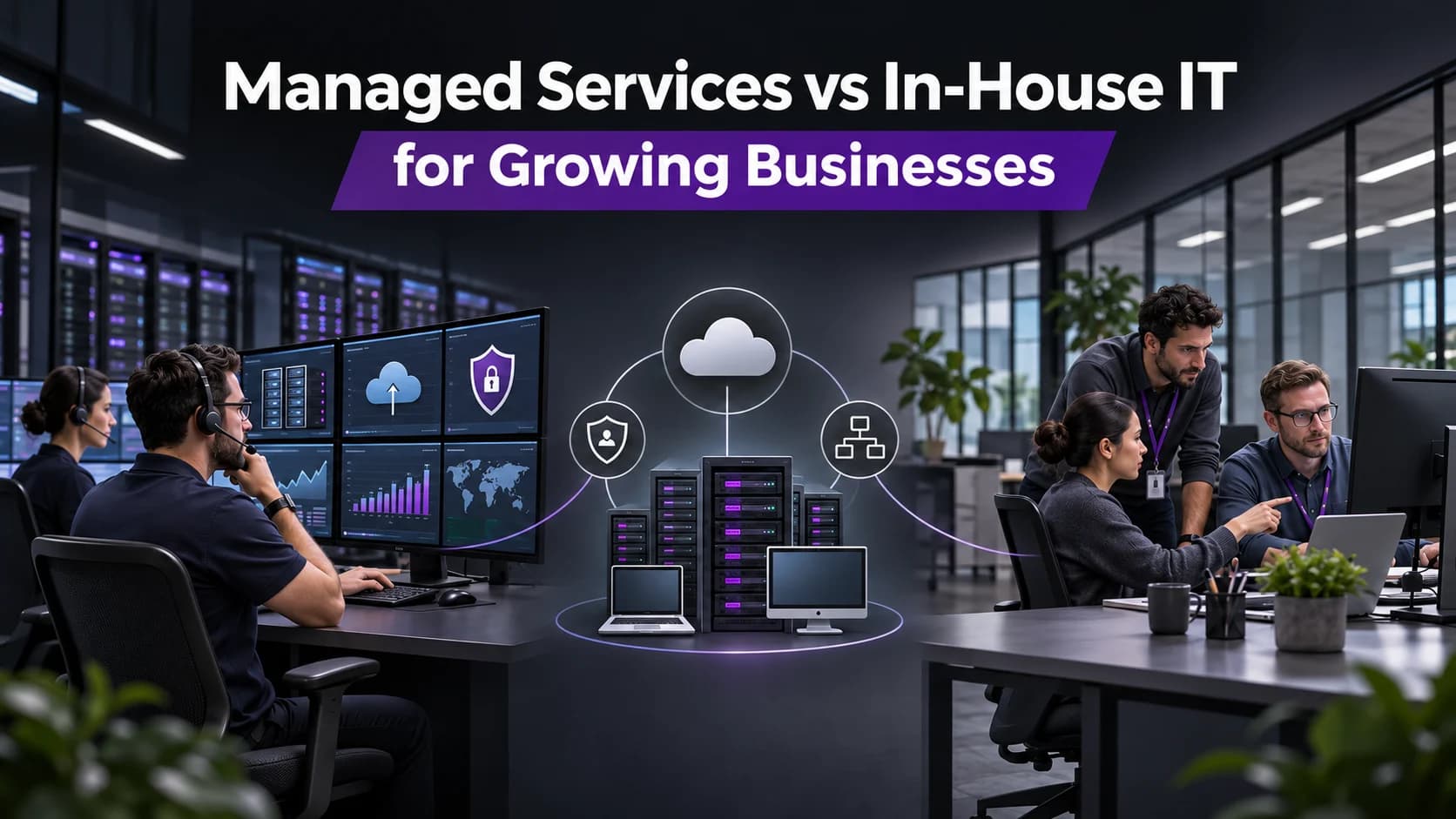
If you're trying to choose between managed services vs in-house it really comes down to your operational needs, skill set and the future vision of your business. At different stages of your business' growth, they offer different benefits.
Quick Answer
Managed IT services are typically ideal for expanding companies requiring expertise, regular expense and also adaptable tech assistance. Internal IT differs from using professionals straight, since it gives more control and, potentially, a better understanding of what goes on behind the scenes. Therefore, certain businesses with even more intricate needs might choose a co-managed approach, which incorporates internal technology teams with external solution carriers.
What Are Managed IT Services?
In managed IT services, IT tasks that both parties agree can be managed externally are outsourced to a service provider by way of a service level agreement.
The provider takes care of certain systems and processes. These may or may not include:
- Networking/Server Administration
- Information technology help desk support
- Cybersecurity monitoring
- Software updates and maintenance
- Backup and disaster recovery
- Cloud Infrastructure Administration
Companies utilizing managed IT services could draw on technical experts from different fields, without having to employ someone for each specific task.
The SLA would normally define the availability of the service, the response time and what responsibilities the provider has.
What Is In House IT?
In House IT is an internal IT department that is in charge of an organisation's technological processes and infrastructure and assists its personnel.
These workers are employed by the company and get a thorough knowledge of the applications, process and their operating procedures.
In house IT may include system administrators, support engineers, security engineers, and IT managers. In small organizations it is common for many of these to be combined within one individual.
Direct supervision is one way to meet the requirement, though costs can be high when the infrastructure increases in complexity, and staffing expertise. Staff attrition and sick leave also affect service continuity.
Key Differences
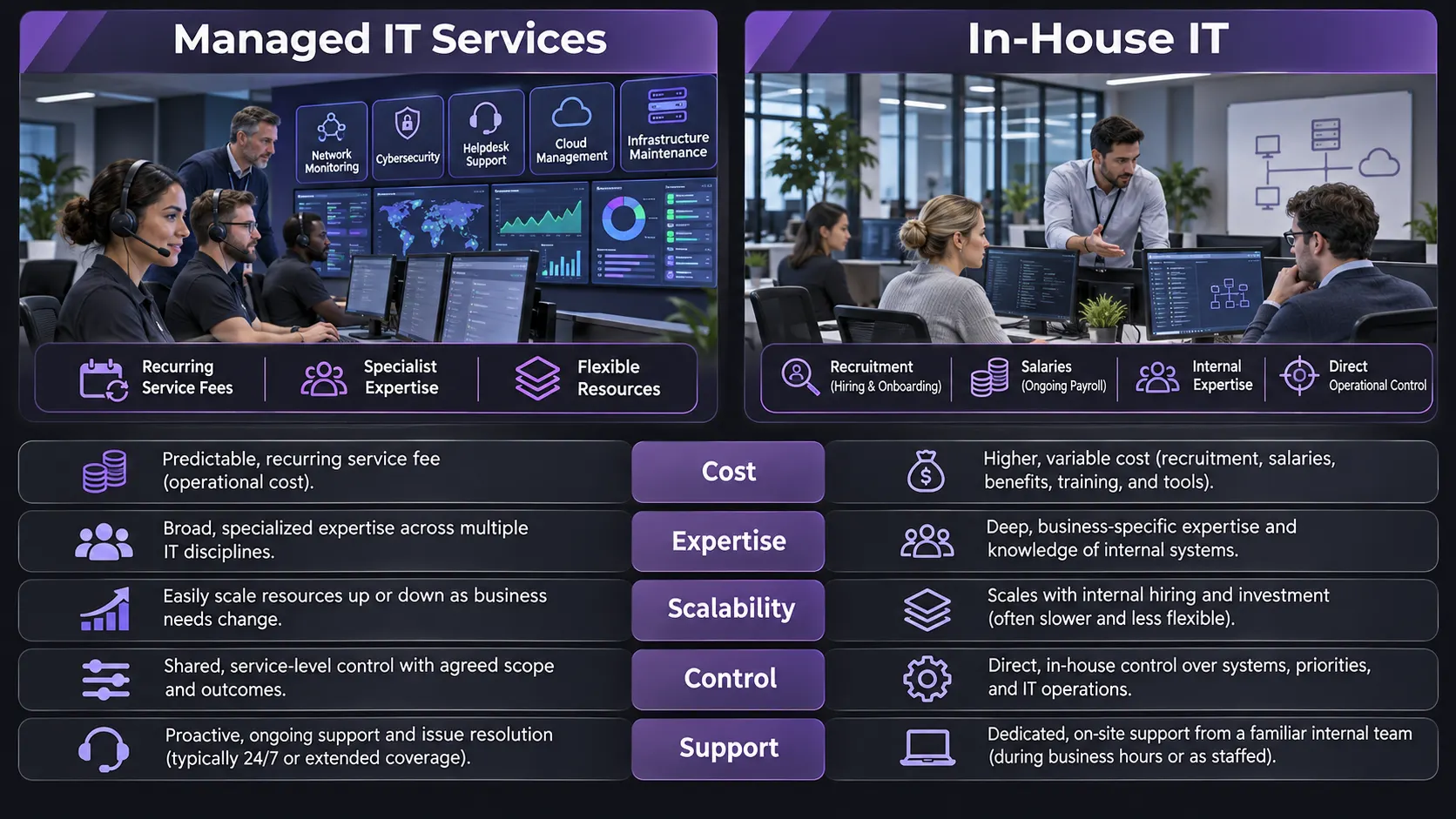
The following comparison explains how the two IT management models differ across common business requirements.
| Comparison Factor | Managed IT Services | In-House IT |
|---|---|---|
| Initial investment | Onboarding and implementation fees | Recruitment, equipment and training |
| Operating costs | Recurring contractual fees | Salaries, benefits and operating expenses |
| Technical expertise | Access to provider specialists | Depends on internal employee skills |
| Scalability | Additional services based on requirements | May require additional recruitment |
| Operational control | Shared according to the contract | Direct internal management |
| Support availability | Based on contracted service hours | Based on employee availability |
| Business knowledge | Developed through collaboration | Established through daily operations |
| Cybersecurity | Specialist services where contracted | Depends on internal capabilities |
| Service continuity | Provider staffing and escalation procedures | Depends on team size and coverage |
Neither arrangement automatically guarantees better performance. The outcome depends on how responsibilities are assigned and how effectively the available resources are managed.
Cost Comparison
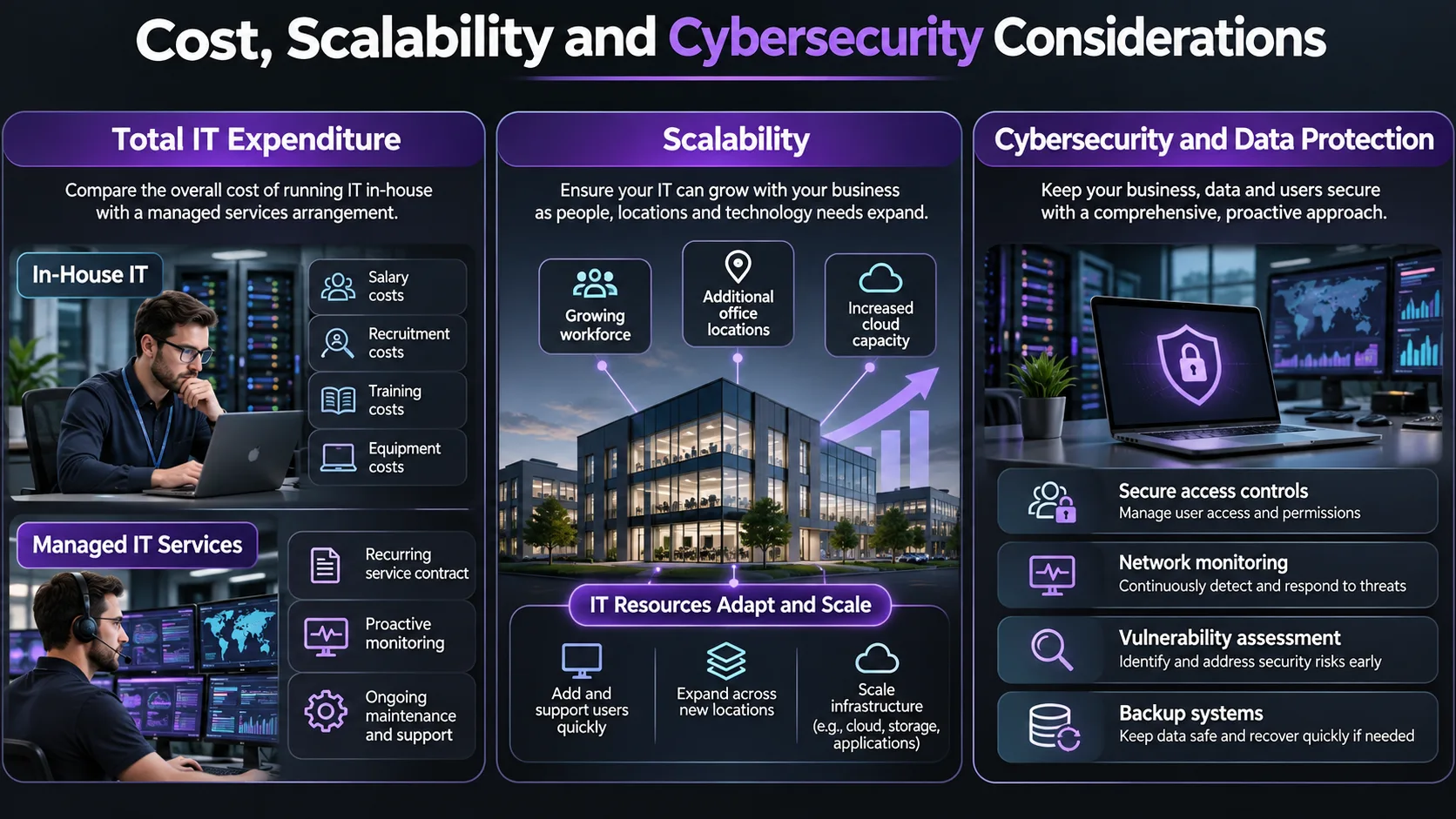
The expense of running an IT department has a lot more to it than just staff wages.
Additional costs include recruitment spend, technical and professional training, licensing of software, and necessary technical equipment. The company may also decide to outsource a project to external experts.
Recurrence based charges: Enterprise managed service providers tend to overcharge on a recurring basis which is often per user or device or over a customised service.
Understanding Total IT Expenditure
| Cost Component | In-House IT | Managed IT Services |
|---|---|---|
| Employee salaries | Direct business expense | Generally covered by service fees |
| Recruitment | Required for new positions | Managed by the provider |
| Technical training | Internal expenditure | Generally handled by the provider |
| Monitoring software | Purchased separately | May be included in the contract |
| After-hours support | Additional staffing or overtime | Depends on service coverage |
| Infrastructure upgrades | Internal project expenditure | May incur additional charges |
It is essential that equal amounts of service have been utilised over the same time scale for a true comparison. Comparing an employee's salary to a full MSP contract can be very deceiving.
And must try to keep an appropriate budget for internal management and the services are not covered by the agreement.
Which Model Offers Better Scalability?
As a company grows, its technology needs evolve. New employees need accounts and equipment, and new office sites need access to secure networks.
Internal IT groups will handle these changes, although they may take time to be able to scale due to having to recruit or train staff in technology skills if not already available.
An MSP can utilize additional technical resources on an ad hoc basis and as per agreed scope of service and availability of capacity.
Organisations that are using digital apps will be able to scale capacity with more powerful cloud infrastructure management.
An online merchant anticipates an uptick in customer orders due to a high season. External partners can review server capacity and application performance monitoring as internal staff focus on business.
Cybersecurity and Data Protection
With the appropriate amount of resources and process definition, both of these management strategies have been shown to successfully provide cybersecurity.
If an internal department owns a sensitive system or process, you will have direct knowledge of company policies. But keeping a tab on your company's security knowhow can be difficult for a small team.
Providing an external vendor with a dedicated security function does give it customer access, and certainly adds another exposure point for third-party risk.
The Canadian Centre for Cyber Security advises that managed service providers establish security obligations, assess security controls and establish a response for when an incident occurs.
The decision to use managed security services should be based on:
- Policies for controlling access and authenticating users
- Vulnerability assessment procedure
- Timeline for notification of security incidents
- Using backup and recovery options
- Ownership of data and confidentiality
- Security reporting and audit procedures
The organisation is ultimately responsible for providing security for its business information, despite some security responsibilities being outsourced.
When Should a Business Choose Managed IT Services?
Managed services can be the answer, if the pressures of technical requirements are pushing past the capabilities of your internal range.
The bottom line: When is it time to outsource?
- Recruiting qualified IT specialists becomes difficult.
- Technical maintenance consumes excessive management time.
- Infrastructure requires support outside normal working hours.
- Cybersecurity requirements exceed internal expertise.
- Expansion requires additional technical resources.
- IT expenditure becomes difficult to forecast.
Your service package should have been developed to meet the business requirement of the provider's contractual obligations. Perhaps a low cost package of service is not an adequate safeguard for an organisation that relies on their computer being available at all times.
When Is In House IT the Better Choice?
The company's line of products or day-to-day operations may make an internal department a better solution.
Employers for which proprietary software, specialised factory systems or sophisticated in-house programmes are critical may look for employees who are highly familiar with their systems.
In house IT is especially appropriate in circumstances where an organisation needs to oversee technical choices on a daily basis, regularly works with other divisions or needs immediate, on-premise help.
It is, however, more financially sustainable if there is a substantial volume of business that can be fixed on-site by specialists.
Co-Managed IT: Combining Both Approaches
A growing business may not have to go with the one model for every IT function approach.
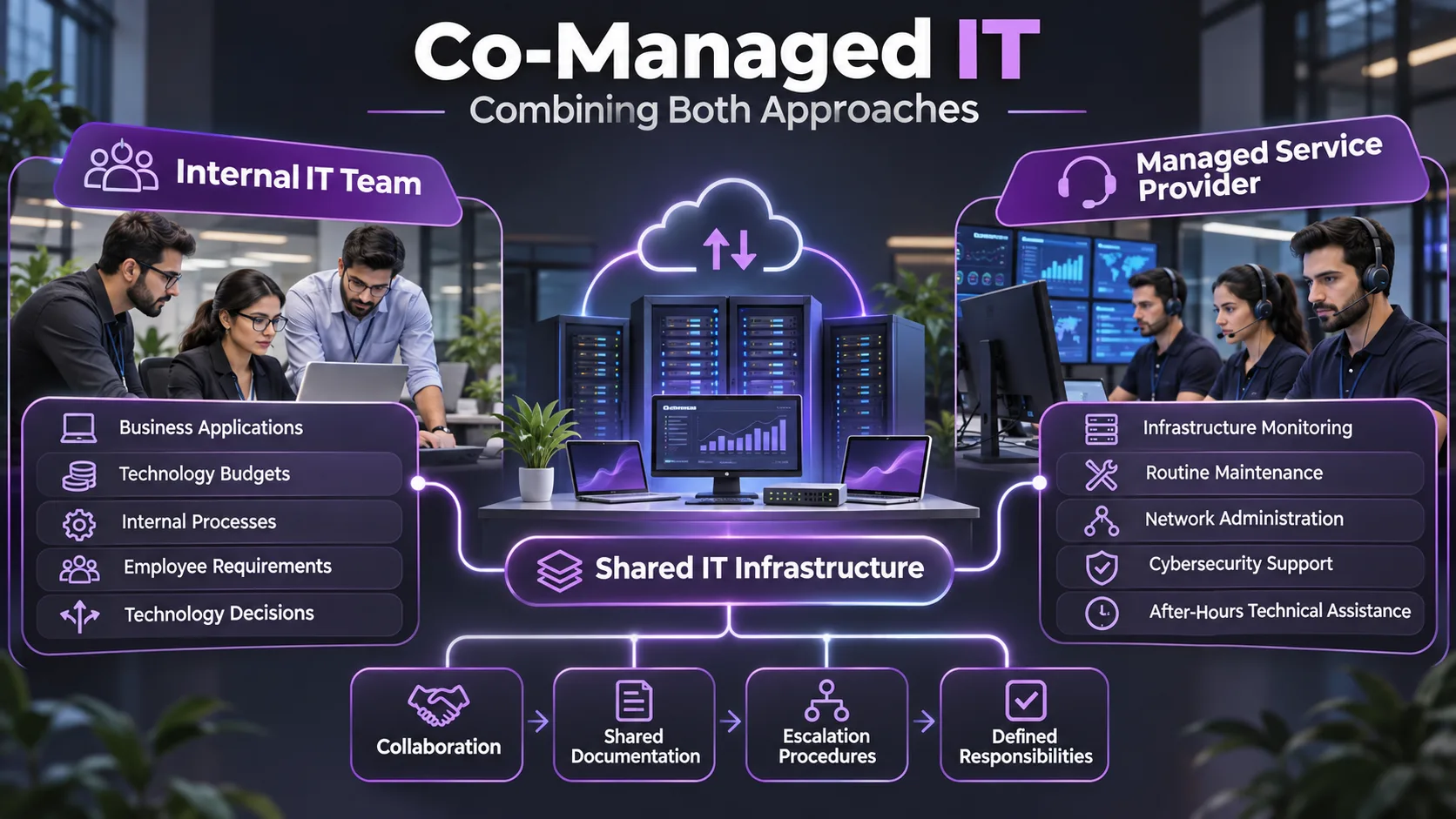
Co-managed IT means internal staff still manages certain systems, while an external provider manages pre-defined operational activities.
Internal vs. outsourced IT services For instance, the internal IT person at a business is likely to manage the business apps, technology budgets and department needs. An MSP might take care of the monitoring of infrastructure, day to day tasks and after hours support.
This allows you to draw on additional technical advice without giving up ownership of your knowledge and decision making powers.
It works when the tasks are clearly distributed, shared documentation and escalation procedures are in place.
How to Choose the Right IT Model for Your Business
Prior to making an IT administration decision, organizations need to evaluate their existing skills and growth estimates.
The paper should provide the answers to
- What computer function needs direct internal control?
- What is the cost of keeping an in house IT department?
- What technical competencies are presently not accessible?
- What assistance is needed after hours?
- How will infrastructure requirements change over the next two years?
Companies must then evaluate all provider proposals based on the above requirements and determine if internal recruitment is providing similar coverage at a comparable cost.
Conclusion
The decision to go in house IT or Managed Services will depend mostly on the business finances, the amount of technical performance that a business requires and the degree of control that the business needs.
Managed services introduce skilled professional resources and agile technical support for growth In house IT support is still vital when you need specific knowledge and frequent on site management. You may find that the balance is best served with co-managed services.
For further information about enterprise technology and IT management, explore MatchBest Software's technology video resources.
Frequently Asked Questions
What is the difference between managed service and IT in-house?
Managed services describe when you outsource certain agreed-upon responsibilities and the in-house IT are employees directly employed by your organisation to manage its technology environment.
Are managed IT services more affordable than in-house IT?
For a company unable to justify a complete specialized department, managed IT services may work out to be more cost-effective. The precise expenses are determined by the infrastructure levels, level of support, staff wages and service contracts.
Which IT model is better for small and growing businesses?
Managed IT services are often an attractive option for growing businesses as they can bring technical support to your business along with providing various service options, all without the need for a large internal recruitment.
Can managed IT services replace an internal IT department?
An MSP can take on numerous day-to-day IT functions. Nevertheless, in-house management of controls over technology purchases, data, and contractual performance should be preserved by an organization.
Is in house IT more secure than managed IT services?
Both models can be equally secure. Security will vary based on technical skill, access, awareness, monitoring, procedures, and risk management.
What are co-managed IT services?
Co-managed IT services refers to a partnership between an organisation's internal IT department and an external co-managed service provider. The split of responsibilities occurs based on the technical nature of the work, the organisation's business needs and the resources available.