

Key Takeaways
Table of Contents
Cloud Security in 2026
The following information has been retrieved from a service provider contract. The AI has retrieved private information about negotiated pricing information which would not have been accessible to the user. This private information was not public in the original document, however, the search index failed to respect permissions for this document.
Cloud Security: By 2026, secure AI workloads are necessary. As such we must think about how to securely protect enterprise data once it has left its source.
Quick Answer
Ensure that workloads are secure by knowing where data is being duplicated, processed and stored. Limit access to each workload and put user permissions in place so that only permitted information is sent to models. Understand how prompts and responses are stored by service providers. Before deployment ensure that unauthorised users cannot access restricted data and that restricted information can be contained within your team.
Where Does Enterprise Data Go When an AI Application Uses It?
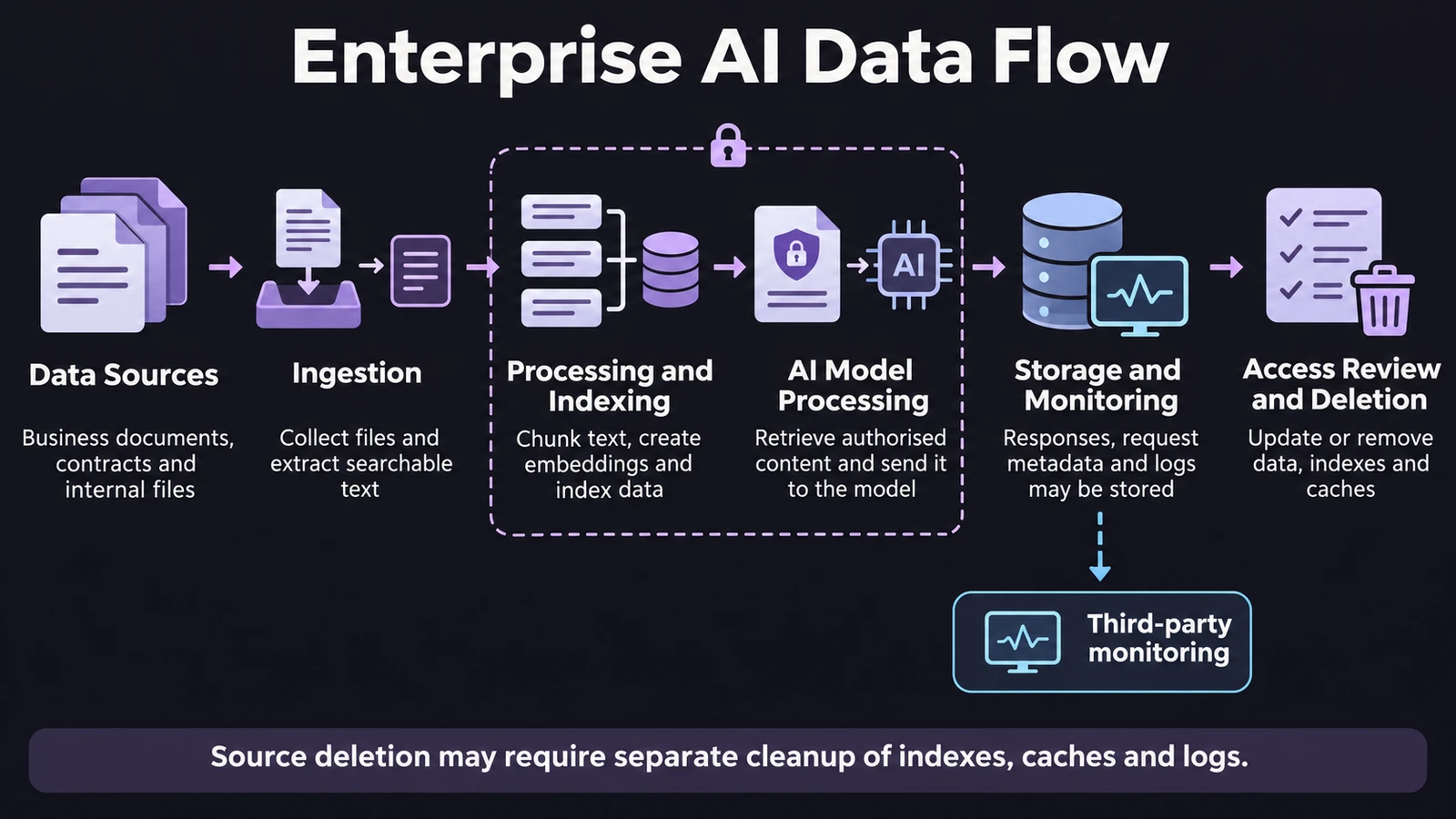
Data might be duplicated within the AI solution. As part of being ingested, the documents may be broken down into searchable text. From here, embeddings might be created and data indexed. Some of this text might be passed to the model, and responses, tracing or troubleshooting logs might be stored.
Create a data flow diagram outlining data inputs, processing, access and deletion by different systems. Consider third party monitoring tools and staging environments. If the data flow stops at the model endpoint it might miss data which is processed prior to, and following, the request.
Consider data governance at an early stage. For example, if a contract is removed or a staff member changes departments, consider how quickly changes need to be made in the AI index, and any cached results. Check that the correct updates are occurring as expected.
Which Cloud Security Controls Should You Put in Place First?
Restrict access for vulnerable and incorrectly configured applications. Depending on whether the model is accessed via a managed model API or self-hosted, there will be different configurations to implement. Regardless of how it is accessed, security should be applied to your application and data.
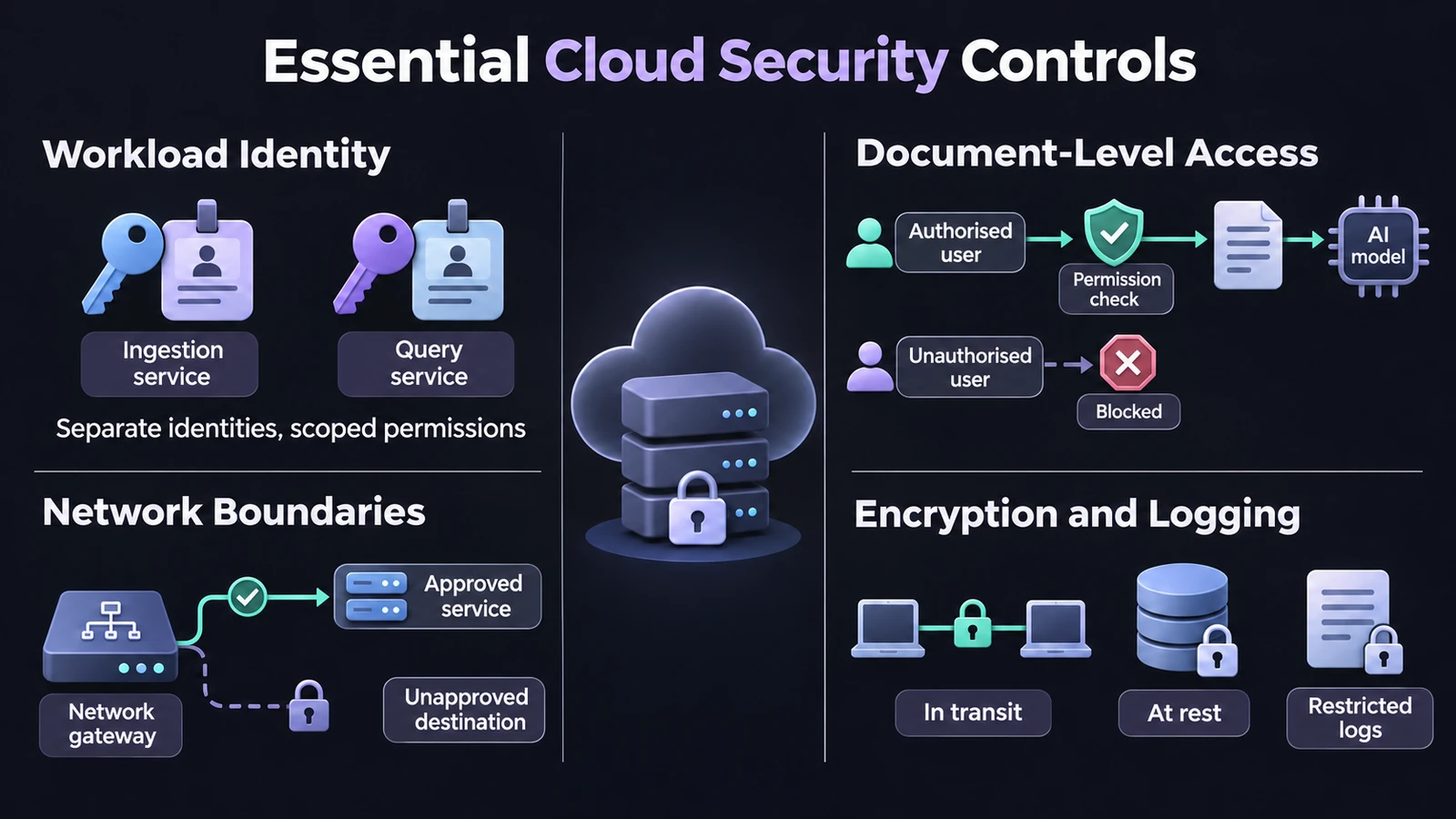
| Control | What to verify |
|---|---|
| Workload identity | Give ingestion and query services separate identities. Verify that the query service can’t modify source documents or index permissions. |
| Access checks | Apply document-level permissions before retrieved text reaches the model. Don’t rely on a prompt that tells it to hide restricted information. |
| Network boundaries | Restrict outbound traffic to approved destinations where practical. Check that debug endpoints and test deployments aren’t publicly reachable. |
| Encryption and logging | Encrypt data in transit and at rest. Keep raw prompts and responses out of routine logs unless there’s a documented need and appropriate safeguards. |
When reviewing cloud hosting, ask which controls your provider operates and which your team must configure. A private connection to a model endpoint can reduce network exposure, but it does not decide whether a particular employee should see a contract.
What Should You Check Before Sending Data to a Managed AI Model?
Different providers might store different amounts of information. If models were trained on user data, or prompts/outputs were logged for monitoring for abuse, then you may get different information. Answer each question individually.
Check that there are no differences between service config, deployment options or regions. You may want to check in your application logs. Even if the provider doesn’t store much data you may still have full requests stored in your observability tooling. Often, it is more useful to know the request ID, date, whether it was permitted and what type of error occurred rather than looking at the document itself.
How Can You Test for Data Exposure Before Launch?
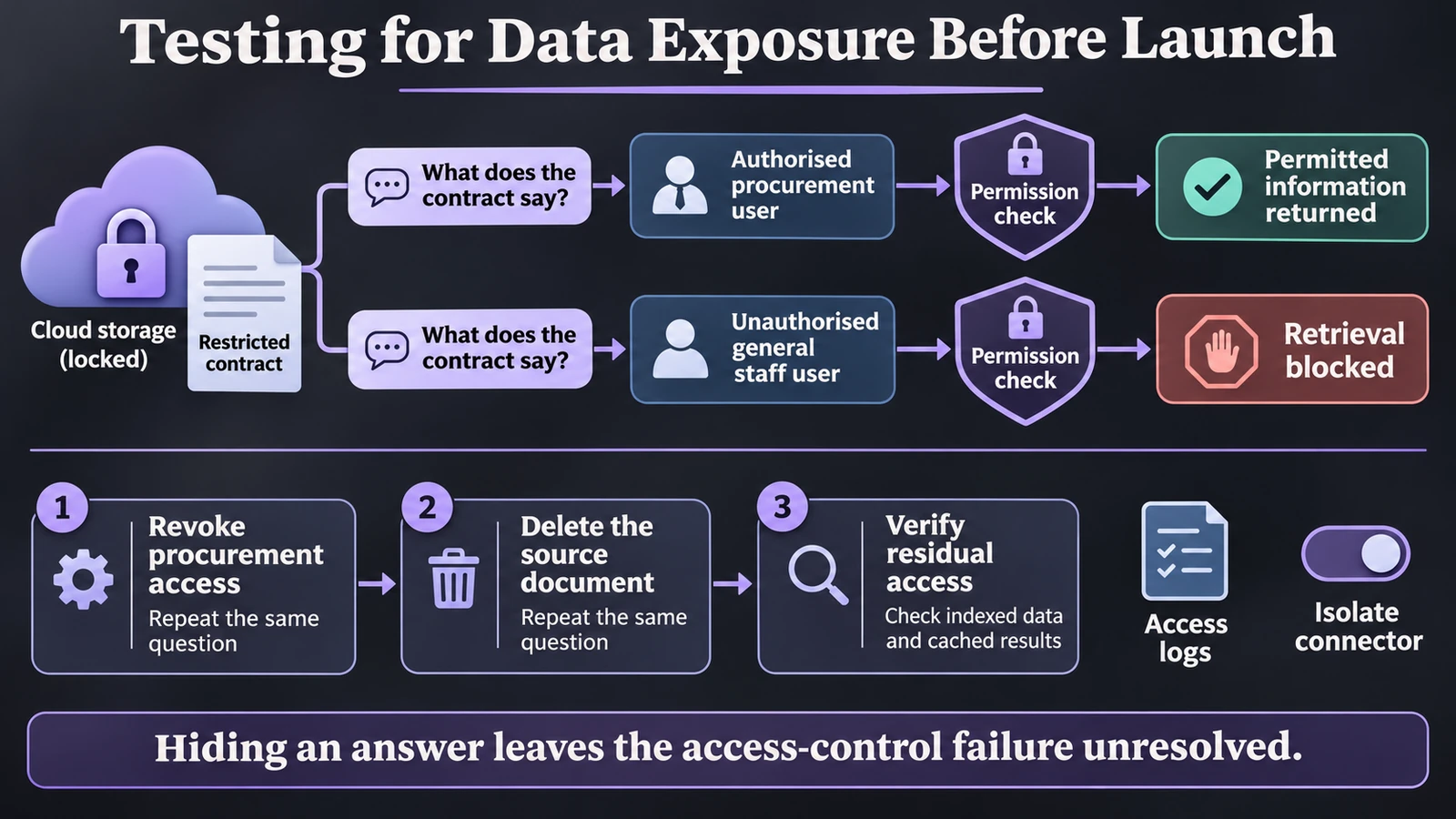
Test by creating a contract with non-standard pricing. Ensure that the procurement test user has access to this contract and that the general staff user does not. Ask both the same question. Confirm the application is behaving as expected.
Only the procurement user should be able to retrieve the contract. The general user should not be able to retrieve the restricted content. Repeat this test with procurement access removed, and also with the source document deleted. If previously returned results are still available, further investigation into the indexing schedule, cache expiry and permissions will be required before scaling up.
Alongside standard infrastructure testing, include this type of testing within security assessments. In addition, ensure that it can be contained. Ensure that there is someone with the ability to prevent retrieval, or isolate the impacted connector. Ensure appropriate audit trails are maintained. Identify the users/systems who may have had access to this data. Simply removing the answer will not prevent the access gap.
Final Thoughts
Within the AI process, ensure that throughout processing (accessing, processing with ML, storing in logs, deleting), you know who can access this data, whether they should be able to, and what happens if access changes.
Test with 2 users with different access to this asset. If the user with restricted access can access this asset, ensure that the access controls have been resolved before making any changes to the prompt. This means that a decision can be made on whether to deploy, and if any further changes are made, these can be retested.
For more on enterprise infrastructure and AI, follow cloud technology updates on LinkedIn.
Frequently Asked Questions
Who is responsible for security?
Implementation of appropriate security controls must be ensured.
If a private endpoint is used, is data securely stored at enterprise level?
Not necessarily. Controls must be put in place to manage access, retention of data and secure logging.
Is it appropriate to store prompts and responses?
No. If data is stored then secure access must be implemented. Sensitive data can be anonymized to add further security. A data retention policy should be considered.
Is there a risk to sensitive documents from search functionality?
Yes. If access controls have not been applied within the application, restricted data could be made viewable within restricted documents.
If it is stated that data will not be used for training, will data not be stored?
Not necessarily. Depending on the service and configuration, data may be stored for operations/monitoring purposes.
When should security be checked?
Before deploying. After any changes have been made to the model, connections, access controls or logging. Regular verification should be performed to ensure access to data is lost and data is deleted.