

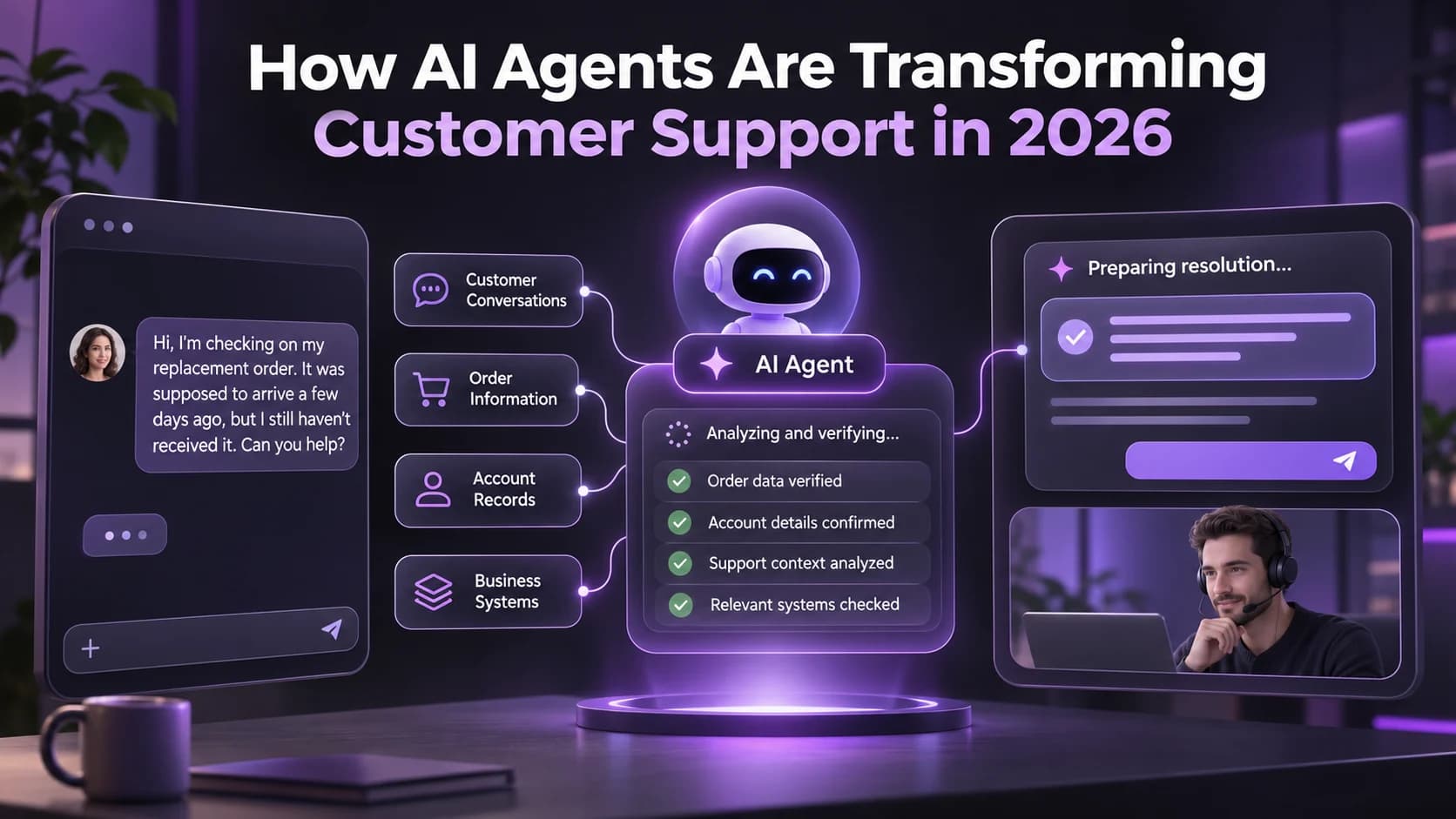
How AI Agents Are Transforming Customer Support in 2026
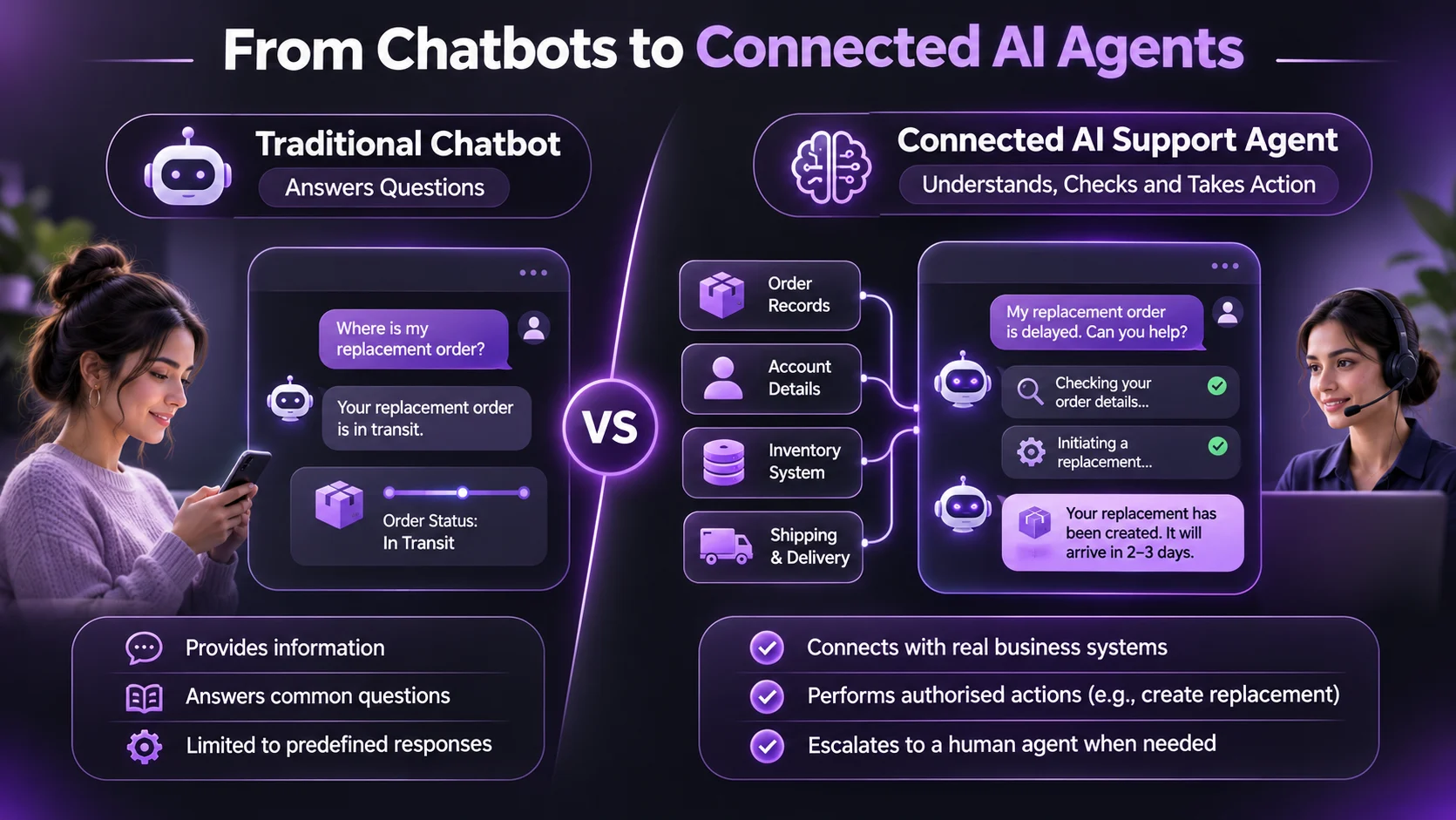
If a customer asks why their replacement order hasn’t been sent out, a traditional chatbot might respond by providing tracking information and directing them to reach out to another team. However, a customer support AI agent could be used to look into the authorised ordering systems and identify any gaps in the process to make sure they know what to do next.
This is important for support teams.
AI agents are starting to become more commonly used within customer support to help resolve everyday issues within a business. This is a valuable tool that will provide accurate information, work with secure integrations and have the option to talk to someone directly if the automation falls short.
Quick Answer
AI agents can be used for customer support by understanding the customer request, pulling relevant information for a specific account and performing validated actions across linked business systems. This is different from a basic chatbot as the agent can orchestrate multiple steps to solve the problem. It's best to start with a small number of workflows and ensure you are seeing the desired outcome, protecting customer data, and having an easy process to pass to a human.
What Has Changed From Chatbots to AI Support Agents?
Question to Action
Whilst the chatbot can provide information on the returns policy, if the AI agent is linked to appropriate tools then it can verify if the order can be returned, make a returns request and send confirmation that the request has been accepted by the system.
Not all chatbots will have static responses. Chat interfaces now have functionality available within them for agents, however the key thing here is whether the system can safely perform actions related to the business.
| Support Request | Basic Chatbot | Connected AI Agent |
|---|---|---|
| Where is my order? | Explains how to track it | Retrieves authorized order status |
| Can I change my booking? | Shares policy and contact options | Checks availability and prepares an eligible change |
| My payment looks wrong | Provides billing guidance | Collects case details and routes them for review |
| I need a person | Offers contact information | Transfers relevant context to a representative |
For companies assessing AI automation and enterprise technology solutions, the question is not how conversational an agent sounds. It is what the agent is authorized to accomplish.
Where Do AI Agents Make the Biggest Difference?
Order & Delivery Queries
Agents can provide visibility into order shipping events, explain what verified means, and raise a follow up case if there are discrepancies in the tracking information.
Do not make up delivery dates or guarantee any outcomes.
Account & Subscription Requests
With appropriate identity checks in place, agents can assist customers with finding the information they need on their accounts or putting together any changes that are allowed to be made.
More stringent authorisation is required for making changes to an account.
Human Support Team Assistance
AI can be used to provide a summary of previous conversations, find approved troubleshooting steps and provide responses to be used by staff.
This can still be useful even if you cannot contact customers or make changes to records.
A broader discussion of AI chatbots in customer experience helps explain the conversational layer. The agentic layer adds controlled access to the systems needed to resolve requests.
How Does a Real Customer Support Agent Workflow Operate?
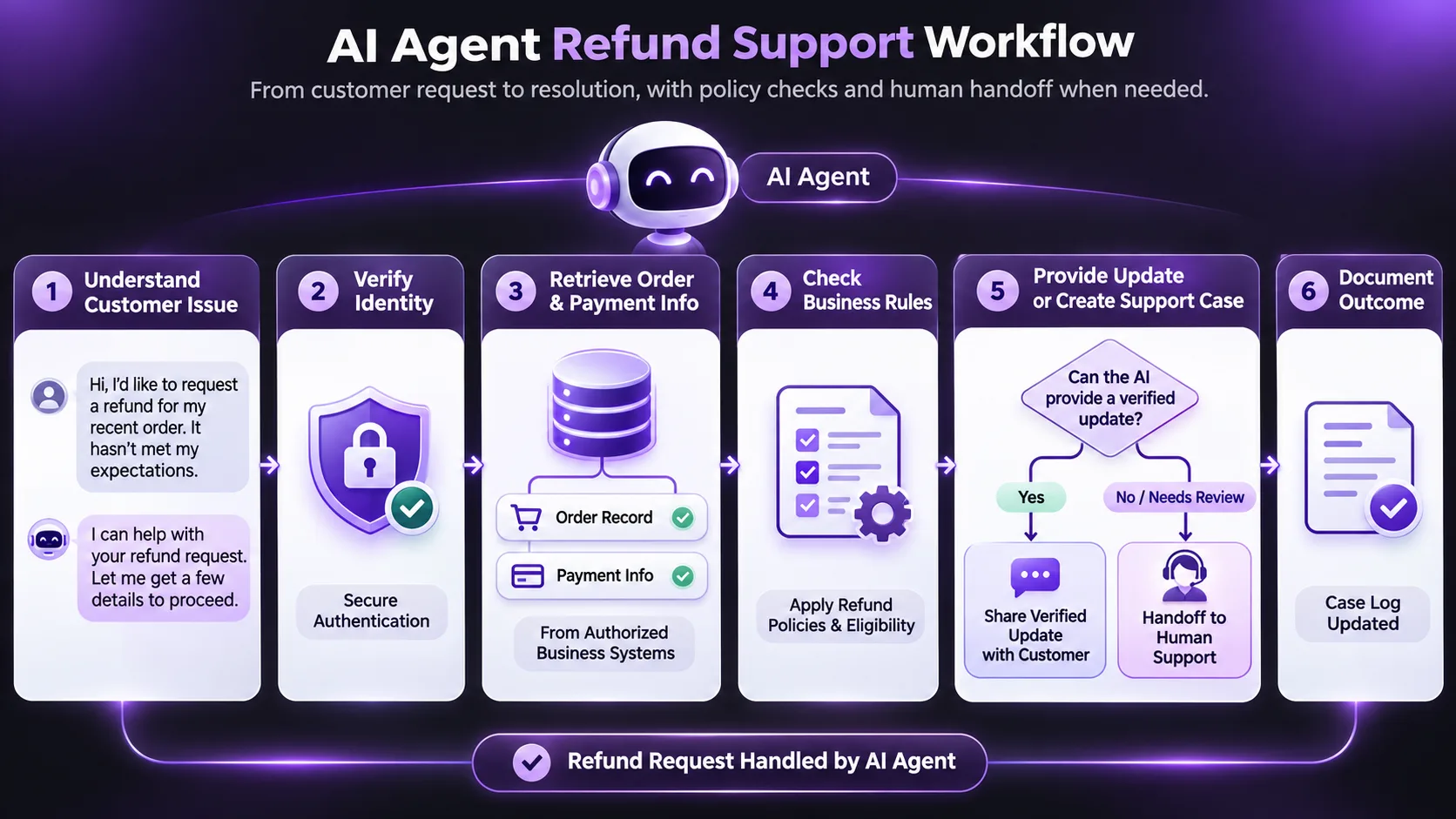
Customer says refund hasn’t been processed.
AI supported process may look like this:
- Understand: Extract order reference, identify concern and identify gaps.
- Authentication: Carry out the businesses authentication process so that account specific information can be provided.
- Look up: Find the order, return and payment status information (based on the permission).
- Business Logic: Identify if the return was completed and if there is an exceptional requirement.
- Action: Provide a verified status update or create a case. Refund or policy exception should occur when requirements are met.
- Outcome: Document what was actually completed by the linked system.
Note: This is just an example and not saying that our product does all of this.
The benefit of this is that it will reduce unnecessary deflections whilst ensuring sensitive decisions are tightly controlled.
Why Does Human Handoff Still Matter in AI Customer Support?
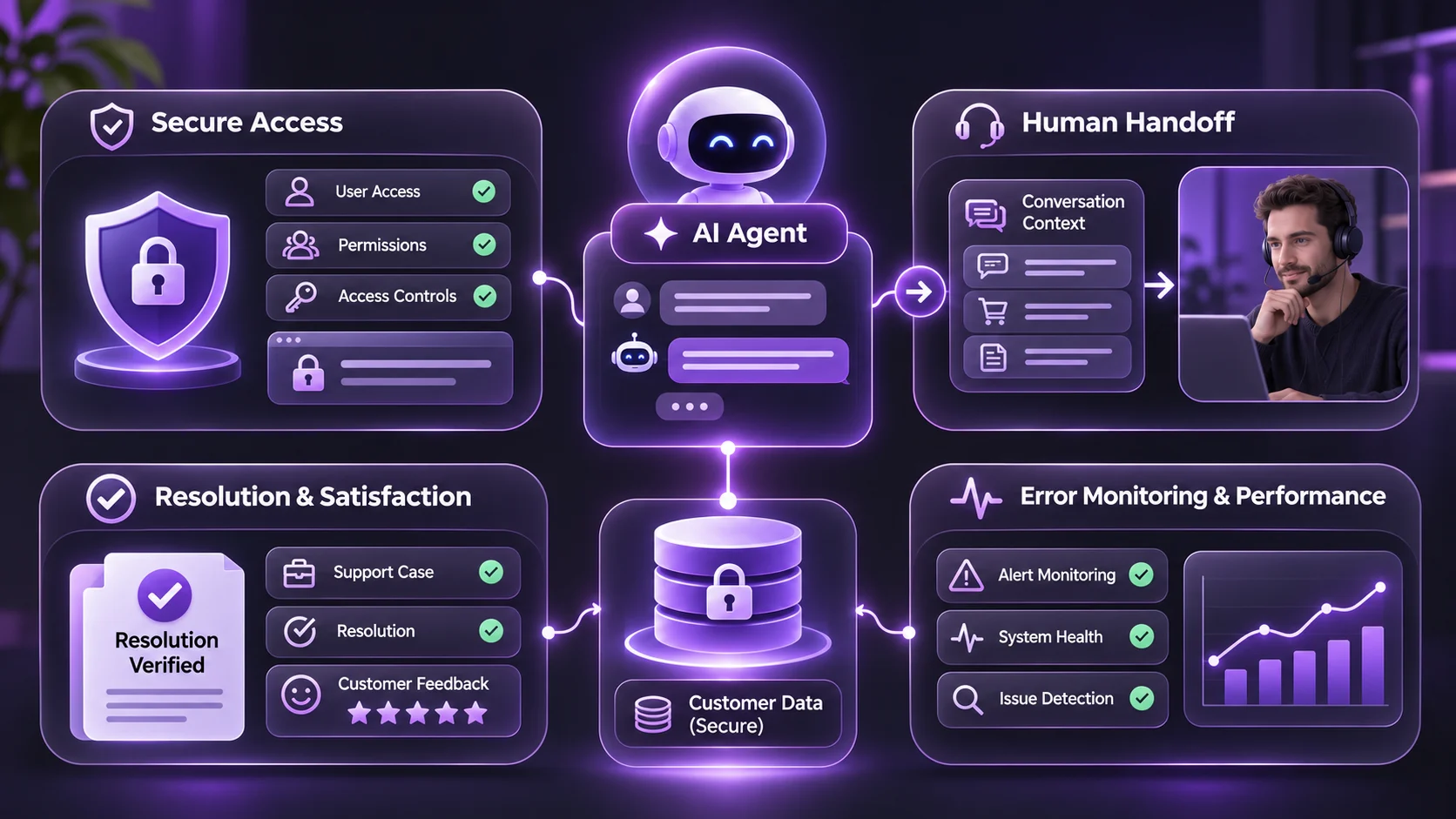
When transferring to a representative they shouldn’t need to repeat their issue.
Including details of what they were concerned about, if they were authenticated, what documents were reviewed, any actions taken, any remaining questions and why they’re escalating will ensure a smooth transfer.
The team should have all this information so they can continue with the case.
Escalation should be available to customers if they ask for it, there is conflicting information, an action couldn’t be done or they have a complaint that needs some empathetic or sensitive handling.
A successful transfer means that the case has been accepted by either a representative or support queue.
It is very important that customers are satisfied with their issue being resolved.
What Should Businesses Protect Before Giving AI Agents Access?
Customer data including address information, transaction history, payment information and personal discussions may be accessible.
Ensure you only have permission to do what is necessary.
Use read only searches, ensure there is a verification process and restrict functionality to what the customer has asked you to do. Keep a log of what has been done.
Sensitive changes should have their own approval.
Businesses should be clear with their customers that they are speaking to an AI and provide an easy way to get in contact with staff.
Accuracy, privacy and transparency are also important to consider.
How Can Support Teams Measure Real Improvements?
Having a low number of transfers to humans does not necessarily mean your support is successful. Customers may give up on their query.
Useful metrics to look at are:
- Verified resolution rate: How many requests have been resolved.
- Customer satisfaction: How satisfied your customers are with your support.
- Repeat contact rate: How often your customers come back with the same issue.
- Resolution time: How quickly issues are being resolved.
- Quality of escalation: Are the human agents getting useful information?
- Error rate: How often agents make or try to make errors.
Compare these against your current support process.
Look at completed cases. If there are any exceptions to the policy, you can see where knowledge may be lacking within the human team. Adjust permissions or processes as needed.
How Should a Growing Company Roll Out AI Support Agents?
Begin with a common low risk area e.g. Order Status.
Define data sources you will accept, the structure of the answers you expect, when to escalate and who is responsible for fixing errors.
Pilot the process with your support team.
Test with missing orders, discrepancies, unhappy customers, broken tools and attempts to make unauthorised changes.
Once you have proven the accuracy and controls of your agent, you can look into extending the functionality.
It could be beneficial to integrate these systems into your wider Intelligent Automation processes if any of your customer issues are related to stock, invoicing or internal services.
However only do so if there is a quantifiable business need.
Final Thoughts
AI agents are changing customer support by taking a business from telling somebody what to do to carrying out verified actions.
They can make it easier to answer simple queries whilst providing more helpful information to staff about complex situations.
The best way to use them in 2026 is to ensure that the correct problems are being solved in a reliable manner. Ensuring that your customers’ data is secure and that humans remain available for situations requiring judgement.
For more insights into AI customer support, intelligent automation, and emerging enterprise technology, follow enterprise AI and technology updates on LinkedIn.