

How to Measure the Business Value of AI in 2026
A new AI automation tool has been introduced within the company. Employees notice faster response times, managers notice less menial work and hundreds of requests have been processed.
However, the finance team asks about the cost saving this has created.
The issue with measuring the ROI of implementing AI automation is that whilst it can lead to quicker processes and more productive employees, it doesn’t automatically result in monetary gains.
Businesses in 2026 need to look at what real tangible gains they have had by investing in AI automation, including full implementation costs and long term improvements.
Quick Answer
AI automation ROI is a measure of how much financial benefit you get from investing in automation. It can be calculated by measuring the benefits a company gets such as cost reductions, increased income, improved productivity and the ongoing costs. To accurately calculate the ROI you will need to ensure you compare the performance before and after using automation, consider any hidden costs and identify actual financial benefits rather than possible efficiency gains.
What Is AI Automation ROI, and Why Does It Matter?
The AI automation ROI provides a clear insight into how effective an AI powered workflow is by showing if it can actually provide financial gains.
This could be due to reduced processing costs, less errors made by employees, increased capacity or extra revenue.
However, there is a difference between increasing capacity and gaining financial value.
In some situations, using AI may save employees time (increasing capacity), however you will only gain financial value if that increased capacity delivers value.
Companies exploring AI automation and enterprise technology services should establish clear business objectives before choosing their automation approach.
How Do You Calculate AI Automation ROI?
The basic formula is Net Financial Benefits divided by Total Investment.
AI Automation ROI (%) = [(Total Financial Benefits – Total AI Costs)/Total AI Costs] x 100
Total financial benefits could be savings and extra revenue generated by AI.
Total AI costs should include the cost of developing AI, software costs, integration, infrastructure, training, maintenance and monitoring for the same time period.
Example: Calculating ROI for Invoice Processing
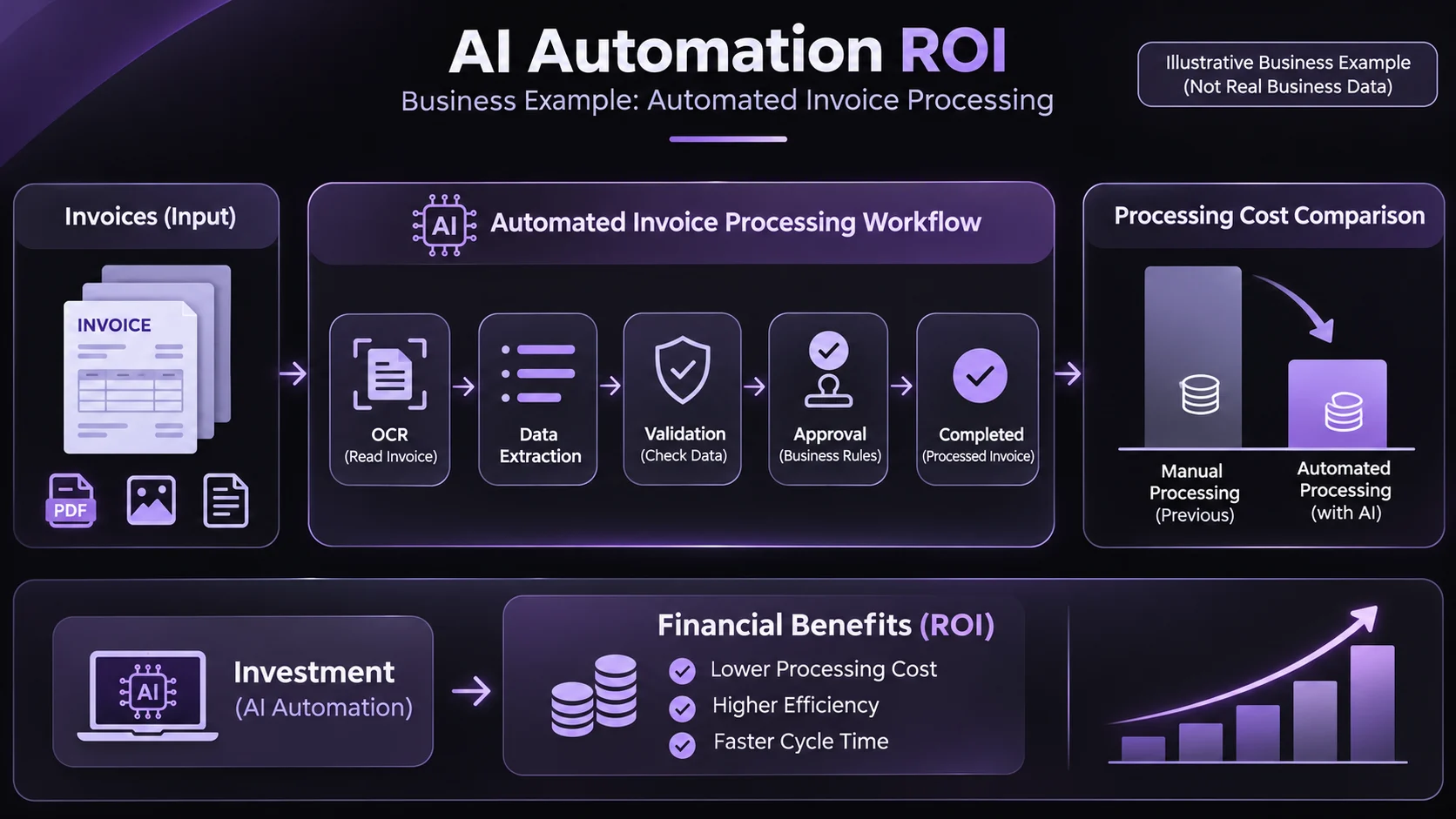
Consider a hypothetical company processing 1,000 invoices every month.
Before automation, its processing cost is $4 per invoice. After implementation, the remaining processing cost falls to $2.50, excluding the new AI system's expenses.
| Measurement | Illustrative Value |
|---|---|
| Monthly invoices | 1,000 |
| Previous processing cost | $4 per invoice |
| Remaining processing cost | $2.50 per invoice |
| Monthly operational savings | $1,500 |
| Annual operational savings | $18,000 |
| Total first year AI investment | $12,000 |
| First year net financial benefit | $6,000 |
Using the formula:
ROI = [($18,000 − $12,000) ÷ $12,000] × 100 = 50%
The example produces a hypothetical first year ROI of 50%, assuming processing volumes remain consistent and quality standards are maintained.
These figures demonstrate the calculation only; they are not industry benchmarks or actual business results.
Which Metrics Best Measure AI Automation Performance?
A reliable ROI evaluation requires more than one performance indicator.
| Key Metric | What It Measures |
|---|---|
| Cost per completed task | Direct processing expense |
| Employee time saved | Reduction in manual effort |
| Task completion rate | Percentage of successfully completed work |
| Error and rework rate | Quality and correction requirements |
| Customer satisfaction | Changes in service experience |
| Automation adoption | Actual usage of automated workflows |
| Additional revenue | Verified sales or revenue contribution |
Identify the right metrics for your business process.
Customer support might benefit more from looking at how effective you are at solving issues and how much it’s costing to solve each case.
Processing accuracy, exception rates and cost savings can be a better indicator for financial processes.
What Costs Should Businesses Include in AI ROI?
One reason businesses overstate the ROI of automation solutions is because they are only taking into account the cost of the solution itself.
In order to fully understand the cost of an automation solution you should take into consideration:
- Initial development: Workflow design, configuration, and application development.
- System integration: Connecting AI with existing business platforms and databases.
- AI infrastructure: Hosting, model usage, API requests, and data storage.
- Employee training: Preparing teams to operate and supervise automated workflows.
- Maintenance and monitoring: Reviewing outputs, correcting errors, and updating systems.
- Security and governance: Access controls, testing, auditing, and compliance requirements.
Accurate measurement also depends on reliable operational data.
Businesses can use data engineering and analytics solutions to develop reporting systems that support consistent performance measurement and informed decisions.
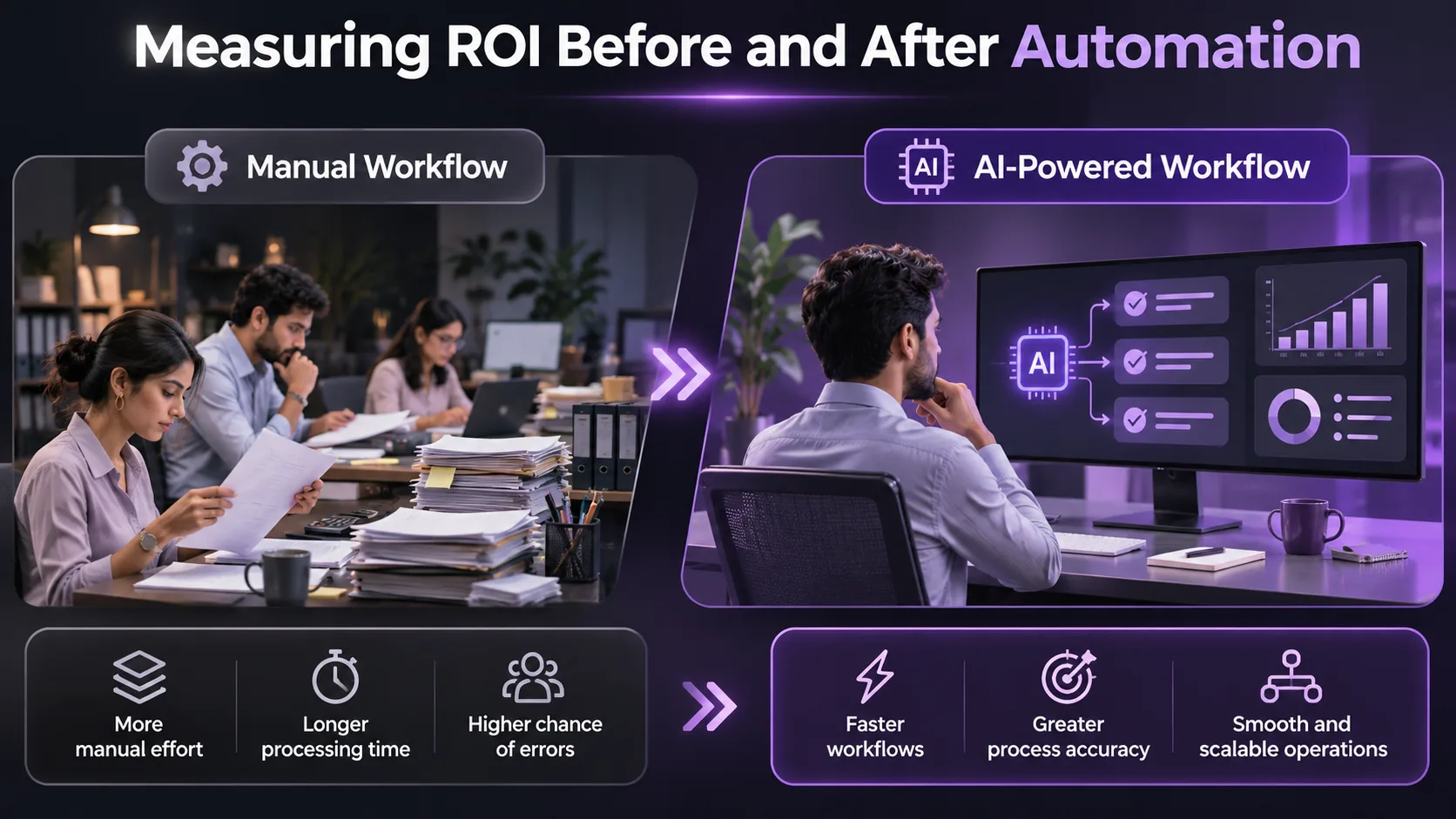
How Can Businesses Measure ROI Before and After Automation?
With a clearly defined process to measure improvements, you’ll easily be able to see how AI has helped improve your operations.
1. Measure Baseline
Keep track of how long operations take, costs, error rates and how much work gets done.
Ensure that you have a clear understanding of how you are going to measure things.
2. Define your metrics
What do you want to achieve? For example reducing the cost of invoices or increasing the number of support requests that are properly resolved.
Ensure that your metrics are not too vague. For example increasing efficiency.
3. Pilot with AI
Automate part of a process or pilot with a small section of users.
If possible create a control group who complete their operations as normal.
4. Measure Real Business Impacts
Look at how much you are spending on processing tasks, how many tasks are successful, how much staff intervention is required and quality.
Are there any other improvements to operations that could impact your results?
5. Calculate and Review ROI
Compare the confirmed financial improvements to your total costs to implement and run. Review regularly.
Why Do Some AI Automation Projects Fail to Deliver ROI?
AI automation won’t necessarily give you a return on investment.
If you are not choosing the right workflows then you may get stuck with expensive integrations with little impact.
Poor user adoption can also cause issues.
There are many other common issues you can run into including inaccurate data, over complication, unexpected costs from how they are used and extra work to fix errors.
You should be aware of what is being automated and what is done correctly.
For systems involving autonomous actions, AI agent monitoring and cost tracking can provide useful visibility into execution costs, failures, and operational performance.
The aim isn’t to automate everything but to improve things in a way you can measure.
How Can Businesses Improve Their AI Automation ROI?
The best place to start is by identifying processes that you can assign a cost to and regularly repeat.
Identify processes that can be automated to reduce your costs, remove unnecessary duplication or increase your capacity within your business. Start small and scale-up once you've seen some real results.
MatchBest Software offers AI automation, agent based platform creation and data engineering services.
This can help you in developing your integrated automation processes.
To begin work on this, simply identify an expensive or lengthy process and work out how much it is currently costing you to complete. You can then set yourself some measurable goals to improve the process.
Final Thoughts
How to measure ROI from automation in AI in 2026
You will want to make sure you are tying automation performance to financial gains, factoring in total cost of ownership and validating that improvements are sustained.
Set a clear starting point, measure one process and build from there.
The most successful AI investment will be the one that produces tangible business benefits rather than the most sophisticated.
For more insights into AI automation, business technology, and digital transformation, follow MatchBest Software on LinkedIn.